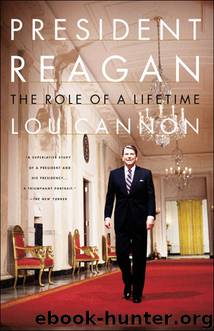
President Reagan by Lou Cannon
Author:Lou Cannon
Language: eng
Format: epub
Publisher: PublicAffairs
AMAJORITY OF Americans strongly backed Reagan’s policies in 1984. While it was often said, sometimes in derogation, that Americans “liked” Reagan, his landslide victory was much more than a personality triumph. Two-thirds of the voters surveyed in the ABC exit polls said they liked Reagan personally, but those (about one in every thirteen) who liked him but disapproved of his policies voted for Mondale. Most Americans not only liked Reagan but agreed with what he was saying, at least on the issues most important to them. “One need simply imagine that instead of talking about God, family and country, the President was extolling Zen Buddhism, unilateral disarmament and sexual license,” wrote sociologist Amitai Etzioni three days before the Louisville debate. “His rating would of course crash within a week. No matter how great an actor he is, the script is still what matters most to most Americans.”7
Americans also believed that Reagan was a leader. When voters in the ABC polls were asked why they liked Reagan, many cited his stand on government spending or said he would keep the nation economically prosperous and militarily strong. But 40 percent of these voters—nearly twice the number who cited any specific issue—said that what they liked most was that Reagan was “a strong leader.” This ratified the opinion of the Reagan campaign team, which had made “Leadership That’s Working” the slogan of the reelection campaign.
The public perception of Reagan’s leadership abilities rested in part on his enduring identification with the values of mythic America, a country of the mind in which presidents are necessarily strong leaders. But the perception depended even more on congressional passage of his budget and tax bills in 1981. White House pollster Richard Wirthlin had observed at the time that most Americans, after years of stalemate between Congress and the White House, viewed congressional approval of administration programs as a sign that government was working. Voters consequently gave high leadership marks to Reagan whenever Congress passed portions of his program. “[This 1981] show of leadership was enough by itself to buy Reagan the time he needed,” wrote ABC polling director Jeffrey Alderman in a 1984 post-election analysis. “It allowed him to survive the worst recession since World War II with much of the public—at Reagan’s urging—blaming the Democrats of the past for the problems of the present. Though ABC/Washington Post polls at the time showed Reagan with an overall approval rating below 50 percent and running behind potential Democratic opponents, the bottom held remarkably firm for Reagan throughout the recession. Unlike Carter, who began losing fellow Democrats when his ratings started to slide as inflation and interest rates rose, Reagan hung onto his core Republican support throughout the recession.”8
Another source of the public’s view of Reagan’s leadership ability was his response when 13,000 members of the Professional Air Traffic Controllers Organization (PATCO) walked off their jobs on August 3, 1981. At the urging of PATCO president Robert E. Poli, the union had backed Reagan during the 1980 campaign, at a time when support from organized labor was rare and highly prized.
Download
This site does not store any files on its server. We only index and link to content provided by other sites. Please contact the content providers to delete copyright contents if any and email us, we'll remove relevant links or contents immediately.
Fanny Burney by Claire Harman(26616)
Empire of the Sikhs by Patwant Singh(23094)
Out of India by Michael Foss(16865)
Leonardo da Vinci by Walter Isaacson(13352)
Small Great Things by Jodi Picoult(7171)
The Six Wives Of Henry VIII (WOMEN IN HISTORY) by Fraser Antonia(5525)
The Wind in My Hair by Masih Alinejad(5110)
A Higher Loyalty: Truth, Lies, and Leadership by James Comey(4975)
The Crown by Robert Lacey(4827)
The Lonely City by Olivia Laing(4811)
Millionaire: The Philanderer, Gambler, and Duelist Who Invented Modern Finance by Janet Gleeson(4493)
The Iron Duke by The Iron Duke(4373)
Papillon (English) by Henri Charrière(4283)
Sticky Fingers by Joe Hagan(4212)
Joan of Arc by Mary Gordon(4125)
Alive: The Story of the Andes Survivors by Piers Paul Read(4042)
Stalin by Stephen Kotkin(3976)
Aleister Crowley: The Biography by Tobias Churton(3651)
Ants Among Elephants by Sujatha Gidla(3476)
